Well, that means you haven't already got one, which is NOT good, but at least you're going to get one.
Get one today.
Get one that sounds an audible alarm, and that has the British Standard ('Kitemark') EN50291.
Better still, get one that has a digital display/readout, and also records peak levels.
One per household is an absolute minimum - one per flame-producing appliance (so one for every fire, boiler, cooker etc. in the house) is the ideal.
Consult the instructions that come with your alarm for the best place to fit it.
Showing posts with label The Basics. Show all posts
Showing posts with label The Basics. Show all posts
Tuesday, 16 October 2007

Tuesday, 10 July 2007
How does CO poison...?
Confused about the toxicology of CO poisoning?
Try this excellent overview from Toxicology in 2003.
Try this excellent overview from Toxicology in 2003.
Monday, 11 December 2006
The Time Problem...
As mentioned elsewhere in this blog, COHb (carboxyhaemoglobin) is NOT a stable compound. It has a half-life of around four hours when you breathe 'clean air (i.e. 21% O2), which shortens the higher the concentration of oxygen you breathe.
So if someone is tested for COHb levels some hours after exposure, those levels will have FALLEN.
COHb testing is like any other clinical investigation- it must be used judiciously and interpreted in light of other clinical findings. As always, an accurate history is often more inportant than getting a high COHb reading. If someone has symptoms suggestive of exposure, and if those symptoms are worse when they are inside their house, those findings are much more important than getting them to score on a CO-oximeter or a breath meter.
So if someone is tested for COHb levels some hours after exposure, those levels will have FALLEN.
COHb testing is like any other clinical investigation- it must be used judiciously and interpreted in light of other clinical findings. As always, an accurate history is often more inportant than getting a high COHb reading. If someone has symptoms suggestive of exposure, and if those symptoms are worse when they are inside their house, those findings are much more important than getting them to score on a CO-oximeter or a breath meter.
Wednesday, 15 November 2006
CO - what is it
Carbon Monoxide is just that - the monoxide of carbon. It is therefore combustible; what it really wants to be is carbon dioxide.
It is produced from the partial combustion of any kind of 'fossil' fuel, and also carbohydrate fuels like wood and paper.
It is colourless and odourless (although the Victorian gas experts say it had an odour of garlic about it.) It is about the same density as air, but since it is usually associated with hot combustion gases, tends to rise in an enclosed environment.
It is produced from the partial combustion of any kind of 'fossil' fuel, and also carbohydrate fuels like wood and paper.
It is colourless and odourless (although the Victorian gas experts say it had an odour of garlic about it.) It is about the same density as air, but since it is usually associated with hot combustion gases, tends to rise in an enclosed environment.
Monday, 13 November 2006
How do I protect myself, and those around me?
It's basic, and simple. Be AWARE of the possibility. That means having a basic knowledge of how CO is produced, and how it gets into people.
Be ALERT to the presence of the gas - it practice this means splashing out £30-£40 on a domestic CO alarm - or even two.
Do NOT think that if your gas fire is burning with a nice blue flame, and not leaving any soot marks, that everything is OK. While it is certainly true that poorly-vented gas-burning appliances will produce soot and a yellow flame, by the time this is noticeable, there will be a LOT of CO around.
If you think that you or your family are in a contaminated building, get out, and do not return until you are sure it is safe. You should not use any suspect appliances until they have been inspected by a qualified engineer.
Be ALERT to the presence of the gas - it practice this means splashing out £30-£40 on a domestic CO alarm - or even two.
Do NOT think that if your gas fire is burning with a nice blue flame, and not leaving any soot marks, that everything is OK. While it is certainly true that poorly-vented gas-burning appliances will produce soot and a yellow flame, by the time this is noticeable, there will be a LOT of CO around.
If you think that you or your family are in a contaminated building, get out, and do not return until you are sure it is safe. You should not use any suspect appliances until they have been inspected by a qualified engineer.
Friday, 10 November 2006
What are the symptoms?
Symptoms of CO exposure range from minimal disturbances through to fairly speedy death. It depends what concentration of CO you are being exposed to, for how long, how big you are, and also how much you are exercising (it's a gaseous poison - so the more you are breathing, the more quickly you absorb it.)
In adults, the commonest symptom is said to be headache. Also, general malaise, fatigue, muscle aches and pains, and eventually uncontrollable somnolence and unconsciousness.
In children, GI symptoms predominate at low-level exposure. This includes abdominal pain, nause, vomiting and even diarrhoea.
In adults, the commonest symptom is said to be headache. Also, general malaise, fatigue, muscle aches and pains, and eventually uncontrollable somnolence and unconsciousness.
In children, GI symptoms predominate at low-level exposure. This includes abdominal pain, nause, vomiting and even diarrhoea.
What are 'safe' levels and 'dangerous' levels of CO?

CO concentration is usually expressed in volumetric parts per million ('ppm').
There is no 'safe' amount of CO to be exposed to, if you ask me. That is, given the choice, I would rather not be breathing any at all, thanks all the same!
150 ppm is accepted by some as a 'safe' exposure for a limited period of time. Many domestic alarms will sound their warning at this level.
Others go by the level of 40 ppm, and nothing more than that.
There is no 'safe' amount of CO to be exposed to, if you ask me. That is, given the choice, I would rather not be breathing any at all, thanks all the same!
150 ppm is accepted by some as a 'safe' exposure for a limited period of time. Many domestic alarms will sound their warning at this level.
Others go by the level of 40 ppm, and nothing more than that.
As part of the British Standard EN50292, domestic alarms sold in the UK must not sound an alarm below 70 ppm - presumably to prevent 'false' alarms. Most experts would agree that exposure to this amount of CO for any length of time is very unhealthy indeed.
The only sensible approach is the 'ALARA' principle - 'As Low As Reasonably Achievable.' No amount of CO is good.
The only sensible approach is the 'ALARA' principle - 'As Low As Reasonably Achievable.' No amount of CO is good.
The pulse oximtery problem
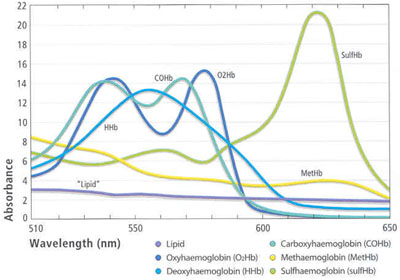
Although COHb does not make you 'cherry pink' to the naked eye, the absorption spectrum of COHb does cause problems with pulse oximetry.
A simple pulse oximeter simply measures how 'pink' the patient's blood is. "If a patient looks pink to you, they look pink to an oximeter." Pulse oximeters are confused by COHb, and read it as oxy-Hb. So someone with, say, 30, 40 50% COHb on board will have a PulsOx reading ticking along quite happily at 98%!
So not only is simple oximetry useless for detecting CO exposure, it is actually misleading in, for example, someone from a house fire.
The important exception to this are pulse oximeters like the Rad 57, which is designed specifically to test for COHb.
A simple pulse oximeter simply measures how 'pink' the patient's blood is. "If a patient looks pink to you, they look pink to an oximeter." Pulse oximeters are confused by COHb, and read it as oxy-Hb. So someone with, say, 30, 40 50% COHb on board will have a PulsOx reading ticking along quite happily at 98%!
So not only is simple oximetry useless for detecting CO exposure, it is actually misleading in, for example, someone from a house fire.
The important exception to this are pulse oximeters like the Rad 57, which is designed specifically to test for COHb.
Thursday, 9 November 2006
How do I test someone?

Bearing in mind the time limitations, testing for CO (or, more accurately, for the presence of COHb) is very useful to 'prove' exposure.
Probably the single most useful tool on the market is the CO-Oximeter. You can see the Rad 57 from Masimo by clicking on this link.
If you are hospital-based, you can also take blood for 'blood gas analysis', making sure your analyser is set to measure for COHb. You do not have to take an aterial sample. COHb is not significantly different in arterial or venous samples, so just take a venous (or capillary) sample in a suitably anticoagulated collector, and measure that.
There are also breath meters like those from Bedfont available. Originally developed to help people give up smoking, but can usefully screen for COHb, especially in the home setting.
Probably the single most useful tool on the market is the CO-Oximeter. You can see the Rad 57 from Masimo by clicking on this link.
If you are hospital-based, you can also take blood for 'blood gas analysis', making sure your analyser is set to measure for COHb. You do not have to take an aterial sample. COHb is not significantly different in arterial or venous samples, so just take a venous (or capillary) sample in a suitably anticoagulated collector, and measure that.
There are also breath meters like those from Bedfont available. Originally developed to help people give up smoking, but can usefully screen for COHb, especially in the home setting.
Monday, 6 November 2006
How do I tell if someone has been poisoned ?
How can I tell if one of my patients has been affected by CO?
Well, it can be difficult. As always, an accurate history is the best starting place. That, and thinking of the possibility in the first place.
For some reason, doctors when faced with more than one person exhibiting similar symptoms thinks 'infection'. Try thinking 'toxic gas' instead, or as well!
Are you looking at more than one member of the household or building occupants with the same or similar symptoms?
Are any PETS in the house behaving oddly too? (Smaller animals, as well as children, are more susceptible than fully-grown adults.)
Do they have any way they could be being exposed to CO? This includes the obvious like gas fires and gas-powered boilers, but also ANY fuel-burning appliance – wood, coal, charcoal, paraffin, oil, etc.
Do they have an adjoining wall or shared chimney with a household that does have any of the above – even if their house does not?
Have they had their gas appliances checked regularly? Have they had their chimneys swept?
One way of 'proving' exposure is to check their COHb level, but you must bear in mind the length of time elapsed between exposure and testing. Read this post for more on this.
Well, it can be difficult. As always, an accurate history is the best starting place. That, and thinking of the possibility in the first place.
For some reason, doctors when faced with more than one person exhibiting similar symptoms thinks 'infection'. Try thinking 'toxic gas' instead, or as well!
Are you looking at more than one member of the household or building occupants with the same or similar symptoms?
Are any PETS in the house behaving oddly too? (Smaller animals, as well as children, are more susceptible than fully-grown adults.)
Do they have any way they could be being exposed to CO? This includes the obvious like gas fires and gas-powered boilers, but also ANY fuel-burning appliance – wood, coal, charcoal, paraffin, oil, etc.
Do they have an adjoining wall or shared chimney with a household that does have any of the above – even if their house does not?
Have they had their gas appliances checked regularly? Have they had their chimneys swept?
One way of 'proving' exposure is to check their COHb level, but you must bear in mind the length of time elapsed between exposure and testing. Read this post for more on this.
Subscribe to:
Posts (Atom)